| ||||
|
Main Menu:
Home Newport Vintage Dance Week Events Calendar Costume Resources Recent News About CVD Related Sites Contact us Page Links: Grand March Waltz Soldiers Joy Lancer's Quadrilles La Tempete Gothic Dance Redowa Waltz Virginia Reel Spanish Dance Ball Refreshments Last updated 9 january 2010/csb
|
The
|
|||
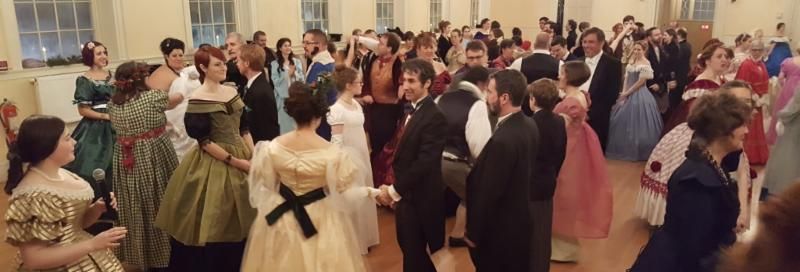
1. THE GRAND MARCHWhile the references to Grand Marches as the opening dance of a ball are many, there are remarkably few descriptions of the figures involved. E. B. Reilley's discussion of in The Amateur's Vademecum (1870), sparse as it is, is more detailed than most: The Grand March generally heads the programme of Balls, Parties, Soirees, &c., and is sometimes performed immediately preceding supper [served buffet style during the major intermission of a ball], and is properly executed as follows: The following figures derive from Dick's Quadrille Call-Book (1878) and George Wilson's Ball-Room Guide (1884), and from Friedrich Zorn's description of the Polonaise (a European processional dance much like a March, but requiring a special step executed in 3/4 time) in Grammar of the Art of Dancing (1887, translated 1905). In general, a March can be led by the first couple if the company of dancers is experienced, or it can be directed from outside the march by the Master of Ceremonies with whatever assistants (floor managers) he has available to him. Grand Promenade: All march around the room, each gent holding the left hand of his partner in his right, either clockwise or anti-clockwise at the will of the leader. Each couple should follow closely behind the couple in front of them. Column of Twos: Having reached the center point at the foot of the hall, the lead couple starts up the center of the hall, all other couples following in turn. Casting off Twos: When the first couple reaches the head of the hall, they turn to the left and proceed around the perimeter of the hall; second couple goes right; third left; and so forth. The first and second couples should slow down to let the following couples close in behind, and they should regulate their speed to arrive at the center point at the foot of the hall at the same time. Column of Fours: The first lady takes the left hand of the second gent in her right, and the two couples march up the hall four abreast, each pair of couples following. The set of two couples, four abreast, is called a platoon. Casting off Fours: First platoon wheels left, the first gentleman marching in place while the second lady curves around. Second platoon wheels right; third left; and so forth. Column of Eights: First and second platoons of four join at the foot of the hall and proceed up, eight abreast, forming a platoon of eight. The other platoons of four do the same and follow in turn up the hall. Casting off Eights and Column of Sixteen are possible if the hall and the number of dancers are both large. The whole series of figures above is often referred to as the March by Platoons. There are various ways of reducing platoons to the Column of Two or Column of One (i.e. single file with each gent in front of his lady, holding hands front to back or without holding hands). One way is to have platoons split in the center as they reach the head of the hall, the right half of the platoon wheeling right while the left half wheels left. When these half platoons meet at the foot of the hall, they fold in one behind the other. This is repeated until Column of Two's is regained. Another way of reducing platoons is by: The Snake: The first platoon starts marching towards the side of the room, following the lead gent who weaves between the platoons behind him. As the last lady of the line passes the lead gent of the next platoon, he takes her trailing hand and his platoon joins the line at the end. Eventually, everyone is following the lead gent. An example of a figure that can be performed in a single file, either with or without joined hands is: The Serpentine: The lead gentleman circles the room repeatedly with circles getting gradually smaller so as to spiral slowly in towards the center. When near the center, he turns abruptly (to the right if he has been circling counter-clockwise, to the left if he has been circling clockwise) and marches out between the coils, all following close behind. Two additional figures suitable when marching as successive couples (column of twos) are: The March in Column: Having marched around the room, the lead couple marches along the wall at the foot of the hall, all the rest following. When they reach the corner and would normally have turned ninety degrees to march up the hall, they instead turn further so as to again march parallel to the wall at the foot, but in the opposite direction. When they reach the wall at the other side, they again turn full around to march back, again paralleling the back wall. They proceed back and forth as they move up the hall, all following. This figure can also be performed by the company when they are in single line. It is an especially useful figure in crowded halls. The Arbor: The first gent and lady step back from each other and reach across to form a pair of arches with their arms. The second couple passes through and then separates to form arches, the third couple passes through both arches and then forms its arches, and so forth. When the last couple has passed the arches formed by the first couple, the first couple follows them through all the arches, followed in turn by the second, third, etc. couples. As the first couple leaves the arches formed by the last couple, they proceed on followed by the other couples. While the original sources usually suggest that couples join hands to form the arches, I have found that a single couple or individual unwilling or unable to march while hunched over can slow this figure to a crawl. I therefore suggest that arches be suggested by each member of a couple reaching up and over towards their partner, but be deliberately back from their partner and not try to touch hands. Passage of the First Half: After the figure Casting off Twos, when the first and second couples meets the second at the foot point, they can, instead of forming Columns of Fours, pass through: that is, the second couple and all those following them (i.e. the original fourth, sixth, eighth, etc. couples) separate and allow the first couple and those following to pass through. When the two columns then meet at the head of the hall, they perform: Passage of the Second Half: This is just like the above, but now the first couple, and those following them, separate and allow the second couple to lead its followers through. There are several more figures described in the sources, and presumably many more that have not been recorded. 2. THE WALTZThe waltz was the preeminent couple dance throughout the nineteenth century. The mid-century waltz differed from the waltz as it was first introduced during the second decade of the century, and differed as well from the waltz of the century's final decades. The dominant waltz of the period is characterized by the lady and gent going alternately one around the other, while that other performs a pivot on the toes of both feet. In addition to this waltz, Hillgrove (1863) describes a simpler waltz that he recommends to those first learning this dance. That simpler waltz is performed as follows, this description being for the gentleman:
The directions above are for the gentleman, but those for the lady are identical except that she will execute the steps corresponding to beats 4, 5 and 6, above, while the gent performs the steps corresponding to beats 1, 2 and 3, and vice versa. These steps should be practiced first without partners, with a line of direction defined along the length of the hall. To perform the waltz, the gentleman places his right arm well around his partner's waist. The gent's right hand must provide support for the lady, who should feel secure about letting her weight rest against this hand. With his left hand, he clasps the fingers of his partners right hand, the two arms forming a gentle curve, the hands at about waist height or slightly (but only very slightly) higher than the waist. Some illustrations from the period show the gentleman's left hand being palm down. This serves to keep the hands low as they should be in this period. The lady's left hand should rest lightly upon the right shoulder (or upper arm, depending on their relative heights) of her partner. If the gentleman feels that left hand grasping the shoulder or shifting to the back of the shoulder, this is usually a sign that the lady does not feel adequately supported by the gent's right hand. The overall movement of the couple should be around the room in an anti-clockwise oval or rounded rectangle. Should you need to stop at any time, be sure to step immediately to the outermost perimeter of the hall or into the middle to avoid collisions with the couples behind you. 3. SOLDIER'S JOYThe formation for the contra dance (or country dance - the terms were synonymous in the nineteenth century) Soldier's Joy is usually described as "Form as for Spanish Dance." This formation consists of a circle of couples facing couples around the room.
All the number 1 couples are facing clockwise, while all the number 2 couples are facing anti-clockwise. Within each set (A, B, C, etc.) the lady (O) stands to the right of her partner, the gent (X) holding her left hand in his right. Each person is facing their opposite; that is, the person of the opposite gender other than their partner within their two couple set. The numbers in parentheses indicate the number of bars of music required for the corresponding movement. There are two musical beats per bar.
If there are insufficient couples to form a circle around the hall, this dance can be performed in a line: first couple at the head of the hall facing down; second couple facing them; third couple facing down with their backs to the second couple; and so forth. When a couple reaches the head or foot of the hall, they turn as a couple (i.e. keeping the lady to the right of the gent) and wait out through one playing of the dance. 4. THE POLKAThis section under construction. 5 - 7. THE LANCERS QUADRILLESThe Quadrille was introduced to the ballrooms of Paris and London in the second decade of the nineteenth century, having derived directly from the French Cotillon, and indirectly from the French square form of Contredance. Early in the century, the Quadrille was performed with elaborate steps, but by the mid-nineteenth century, etiquette and dance manuals universally concur that dancers should walk or glide smoothly through the figures. While it is now customary for a prompter to call the figures, it is pretty clear that popular Quadrilles, and the Lancers' was one of the most popular for most of the century, were expected to be known by those participating. Many etiquette and dance manuals warn against standing up to dance a Quadrille if the figures are not known; while some suggest that an imperfect memory can be aided by joining as a side couple (i.e. couple 3 or 4). It appears from the few dance cards available from the mid-nineteenth century that the majority of dances at a ball would be Quadrilles. This is impractical in any context where each figure of each dance has to be taught before being performed. The Quadrille is danced by four couples arranged in a square, the distance between opposite couples being about 12 feet. The couple nearest the head of the hall (as defined by the precepter of the ball) is the first couple; opposite them is the second couple. Together, these are the head couples. The couple to the right of the first couple is the third couple; opposite them is the fourth couple. Together, these are the side couples. In general, each figure of a quadrille begins with a full 8b of music by way of introduction. During the first figure, this introduction is used for bows and courtesies to partners and to corners. No bows are made before subsequent figures. Final figures often (as here) omit the introduction, substituting a single chord by way of preparation. First Figure (24 bars): "Les Tiroirs"
This entire figure is repeated by the head couples, this time with the second couple passing through the first on the Cross Over and around the second on the Cross Back. The figure is then performed twice by the side couples, the first time with the third couple splitting the fourth on the Cross Over, the next with the third couple being split by the fourth on the Cross Over. Middle (originally the Third) Figure (16 bars): "Les Moulinets"
This entire figure is repeated exactly as above, and is then performed two additional times with the side couples carrying out the Forward and Back and Forward and Salute. Final (originally the Fifth) Figure (48 bars): "Lanciers"(After initial chord, the figure commencing with the music)
This entire figure is performed four times and then ends with a final Grand Right and Left. The second time, the second couple performs the Promenade with the fourth and third couples falling in behind; the third time, the third couple promenades and the second and first couple fall in behind; the last time, the fourth couple promenades and the first and second couples fall in behind. In each case, the couple performing the Promenade also performs the March down the set and back up. 8. THE GALOPThe Galop, or Gallopade, is a simple dance consisting of no more than a series of chassez steps with an occasional half-turn by the couple so that subsequent chassez steps performed to the other side continue to carry the dancers anti-clockwise around the hall. The position adopted by each couple is the same as in the Waltz or Polka. The basic chassez step of which it consists is like that in the Polka, but without the upbeat hop. The is, the gent, facing out from the center of the hall begins by steping, or sliding, to the left, letting his weight shift the that fott (count 1). He then springs off his left foot just enough to enable him to bring his right foot into the place of the left, and landing on the right, allows his left foot to be displaced to the side in anticipaion of stepping onto itmomentarily (count &). The step with the left and displacement of the foot by the right is then repeated a total of seven times (count 1&, 2&, 3&, 4&, 5&, 6&, 7&). On count 8, the gent again steps onto the left foot, but this time stepping diagonally across in front of his partner while allowing his upper body to begin turning clockwise with his partner. On the final count '&' (after count 8), he springs or hops very slightly on the left foot, allowing him to complete a half turn clockwise with his partner. Landing on the left foot, and now facing into the center of the hall, his right foot is now free to step to the right, still moving anti-clockwise around the hall. The gent then performs seven chassez steps (count 1&, 2&, 3&, 4&, 5&, 6&, 7&) to this side, and on count 8, steps between his partner's legs, again turning clockwise, and finishes the half turn with a slight spring or hop on the right, leaving his left foot free to step or slide to the side as at the very beginning. The step for the lady is the same, except that she begins with the chassez steps to the right, and then performs the chassez steps to the left only after the half turn has occurred. It is entirely permissible to do more than seve chassez step before turning, but the turn, when it occurs, should always be at the point in the musical phrase corresponding to the count '8&,' as the lady is unlikely to be expecting it at other times. In impending turn is indicated to the gentleman by a slight tightening with the right hand at the end of the previous chassez step, and with the beginning of the turn at count 8, which turn is what allows the gents left foot to step easily in front of the lady. Hillgrove (1863) comments that, It can be made very pleasing and entertaining by the dancers, in couples, forming a column. The whole party then follow the leadrers, or head couple, through a variety of serpentine courses, now winding themselves in circles, and anon unwinding to create new ones. 9. THE WALTZSee 2, above. 10. THE POLKASee 4, above. 11. LA TEMPETEA line of four, two couples side by side, facing down the hall. Facing them a similar line of four. Then another line of four with their backs to that line, an so on down the hall.
The version above follows Hillgrove (1863). In narrow or crowded halls,
the chassez figure (the second 8 bars of the dance) can be a problem as eight
chassez across takes up a lot of space. A more compact alternative, though
not one I've seen in any of the period sources, is to perform four chassez
across and back, describing an anti-clockwise oval, and then four chassez
across and back describing a clockwise oval. Howe (1862) has the first 8 bars
as The pass through during the final 4 bars of the dance is often performed by everyone releasing hands and passing the person opposite by the right shoulder, joining hands into a line of four after passing. 12. THE POLKA REDOWAThis section under construction. 13. THE SCHOTTISCHEThis section under construction. 14. THE GOTHIC DANCEA line of gentlemen holding hands down the line facing a line of ladies holding hands down the line. As many as 15 or so couples may be in each set.
The dance continues at least until all couples have performed the figure and the original head couples are back at the head position. The final 12 bars of the dance (the head two ladies going around their respective partners and the chassez down the set) should have something of the quality of a race, but safety must be observed at all times as it is easy to become off balanced during the chassez steps. Gentlemen must be careful not to rush their partners who are likely to be encumbered by rather voluminous gowns. If the ladies are unwilling to make haste during the circling of their partners, modify the figure to have them pass only once under the arch. It is imperative that the two couples reach the foot of the set and fall into line before the ladies start forward for the repeat of the dance. I am aware of only one source for this dance, Elise Howe's American Dancing Master (1862). To the best of my knowledge, this dance had not performed for over a century prior to my introduction of it at Civil War reenactment dances several years ago. 15. REDOWA WALTZThe Redowa Waltz, or Redowa, is a wonderfully exhilarating variation on the waltz. The dance is described in a myriad of sources; but the descriptions are not entirely consistent with each other. Within the modern Vintage Dance community, the interpretation first reconstructed by Mr. Richard Powers has become the standard. While this dance is not significantly more difficult to perform than the plain waltz, it is rather more difficult to learn from a written description, and so we adopt here the view expressed by Edward Ferrero in The Art of Dancing (1859): No description that we can give could convey any idea of the step of the redowa, the motion being of a peculiar character. It is composed of the pas de basque step. To acquire the redowa properly one should be au fait in the plain waltz. In any case, a plain waltz can always be danced to redowa music. 16. VIRGINIA REELA line gentlemen facing a line of ladies, all standing opposite to their partners. While the number of couples can vary, sets longer than five or perhaps six couples take a long time to finish the dance.
Part 1: The lady at the head and the gentleman at the foot commence each
figure, and are immediately followed by the foot lady and head gentleman.
Part 2: The head couple join right hands and turn once and a half round (that is, go once around and then pass by the right shoulder giving left hand to the second lady or gent). The head lady then turns the second gent by the left hand while the head gent turns the second lady by the left hand. The head lady and gent then turn each other by the right hand; then the third by the left; then each other by the right; and so forth down the set. Part 3: When the first lady and gent meet at the foot of the set, they give right hands and go halfway round and face up the set side by side, the lady to the gent's right. They then give left hands below the right (promenade hand position) and march up the inside of the set. When they reach the head of the set, they separate, the lady turning to the right and passing down the outside of the ladies' line with all the ladies following, and the gentleman turning to the left and passing down the outside of the gentlemen's line with all the gents following. They all follow to the foot of the set, meet their partners at the foot, and return up the inside to places. The first couple then join hands, chassez down the middle (those below separating into their lines), and take their position below the last couple. Then the figure repeats with a new couple at the head. The dance continues until all couples have performed the figure and the original head couples are back at the head position. As different sets will tend to reach this point more or less quickly (Parts 2 and 3 have no fixed durations, and different sets will have different paces), some sets will be finished before others. I usually encourage sets to start over with the head couples repeating the figure as at the beginning until the music ends. It is the task of the dance director to insure that the musicians play until the last couple in the slowest set has finished the figure. It is difficult to give calls such as Head lady and foot gent forward and back, etc. in a timely manner as well as hard for the dancers to distinguish when they are meant, so I usually define the head lady and foot gent as the first diagonal, and the foot lady and head gent as the second diagonal. The call then becomes First diagonal forward and back , etc. Note that after the first time through one cannot give calls to the hall at large unless all sets are together. There are several legitimate mid-nineteenth century versions of this dance
and many more later versions. The above is as in Hillgrove (1693), though
omitting a final tag: 17. SPANISH DANCEThe Spanish Dance or Spanish Waltz is a contradance in waltz time (i.e. 1 bar is three beats). The formation consists of a circle of couples facing couples around the room.
All the number 1 couples are facing clockwise, while all the number 2
couples are facing anti-clockwise. Within each set (A, B, C, etc.) the lady
(O) stands to the right of her partner, the gent (X) holding her left hand in
his right.
The progressive figure of Circle and Pass on to the Next can be made with eight turning waltz steps. That is, the couples finish the Left Hand Moulinet and, taking closed ballroom positions, the two couples of a set waltz once full around each other and then waltz past each other (all in 8 bars), each opening out at the end of the eight bar to face the next couple ready to repeat the dance with a new couple. If there are insufficient couples to form a circle around the room, this dance can be performed (and is occasionally so described in the sources) in a line: first couple at the head of the hall facing down; second couple facing them; third couple facing down with their backs to the second couple; and so forth. When a couple reaches the head or foot of the hall, they turn as a couple (i.e. keeping the lady to the right of the gent) and wait out through one playing of the dance. The description of the figure All Balance Forward and Turn given above is based on the description in L. De G. Brookes's manual, Brookes on Modern Dancing (1867). It is entirely consistent with the description in many other sources, but is far more detailed and specifies the turn by two hands. Most sources are quite vague on this point, Hillgrove (1863) being typical: . . . forward again, and exchange partners, turning quarter round and face each other, but at right angles from the first position. This vagueness has lead to a number of alternative interpretations, of which the prettiest is to have the gent take the lady's left hand in his right and then, raising these hands high, have the lady step forward and rotate one quarter to her left while the gent steps forward, passing right shoulders with the lady, and rotates one quarter to the right. The distinctiveness of this figure, however, makes it all the less likely that it was the intended figure, as it is difficult to imagine that all of the various available sources would have omitted all reference to the lady passing under the arch of the gentleman's arm were this intended. Another source which provides clear instructions for this exchange of partners is Dick's Quadrille Call-Book (1878): Couples forward one step again as before, count three; the gentlemen remain, the ladies cross over, placing left hands in opposite gentleman's right hands, count three. The new partners turn partly round so as to occupy the sides of the square. In practice, this version is essentially the same as Brookes's, above, except that Brookes has the ladies' right hands briefly in contact with the gentlemen's left as the ladies cross over. I find this last version slightly more attractive, but the Brookes has the advantage of earlier publication date, and also eliminates the problem for inexperienced dancers of having to remember which hand in actually involved in the exchange. APPENDIX - BALLROOM REFRESHMENTS(Barbara thought that a few sample recipes for punch and cookies/cakes would be useful to folks - I agree. She is planning on keeping it very short. In the meantime, here are some items we have used at our balls) Chocolate Kisses (1846)
Preheat the oven to 250 degrees F.
Source: Turner's Improved Housekeeper's Almanac for 1846 (Philadelphia: Turner & Fisher, 1845.) unpaginated. Redacted by William Woys Weaver, The Christmas Cook. New York: Harper Collins, 1990, p. 225. Cocoa-nut Cakes (1853)
Peel and grate a cocoa-nut and take half its weight in sugar and one white of egg. Mix and form into balls, and bake on a buttered tin sheet. Source: Mrs Chadwick, Home Cookery, 1853, p. 26 Iced Grapes (1872)
Choose perfect bunches of grapes; discard any blemished grapes. Trim the bunches to the desired size, then, for convenience in hanging the grapes to dry, tie a string to the stem of each bunch. Be certain the string is tied securely. Dip a paintbrush into the unbeaten egg whites and brush the grapes only enough to lightly moisten then. Dust liberally with superfine sugar. Touch up spots where the sugar misses and then hang the grapes to dry. Tie them to a clothesline or towel rack with the strings you have attached to the stems. When the sugar is dry, remove the strings and use the grapes in constructing the table centerpiece. Source: Mrs. Winslow's Domestic Receipt Book for 1872 (New York: Jeremiah Curtis & Sons and John I. Brown & Sons, 1871), 31. Redacted by William Woys Weaver, The Christmas Cook, p. 237. Lemon Biscuits (1861)
Mix ingredients, drop on cookie sheets. Bake at 350 F for 15-20 minutes. (These are nice with an icing of powdered sugar mixed with lemon juice.-BMP) Source: Beeton, Isabella. The Beeton's Book of Household Management. London; S.O.Beeton, 1861. Facsimile reprint: London, Chancellor Press 1982. p. 850. Redacted by Barbara Pugliese. Little Plumcakes (1810)
Preheat the oven to 375 degrees F. Cream the butter and sugar. Beat the eggs to a thick froth and combine with the sugar mixture. Sift the flour and spices together twice. Fold the currants into the batter, then sift in the flour. Thoroughly work the ingredients together to make a very stiff dough. Break off pieces and roll them into balls the size of walnuts. Set these on baking sheets lined with baking parchment. Bake in the preheated oven for approximately 15 minutes, or until golden brown on the bottom. Cool on racks or serve immediately. Source: Maria Rundell. A New System of Domestic Cookery (Philadelphia: Benjamin C. Buzby, 1810), p. 198. Redacted by William Woys Weaver, The Christmas Cook. New York: Harper Collins, 1990. p. 128. Meringues (1861)
Beat egg whites, slowly adding sugar and lemon juice, until very stiff. (Mrs. Beeton does not call for lemon juice. - BMP) Drop by tablespoons onto paper or aluminum foil. Bake at 250F for 45 min, then turn off heat and leave in oven to dry. Makes 40 kisses. You can color half the recipe pink with food color -- Mrs. Beeton uses cochineal. The combination of pink and white is very pretty. Source: Beeton, Isabella. The Beeton's Book of Household Management. London: S.O.Beeton, 1861. Facsimile reprint: London, Chancellor Press, 1982. p. 730-731. Redacted by Barbara Pugliese. Nice Wafer Cakes (1853)
Source: Mrs. J. Chadwick, Home Cookery. Boston: Crosby, Nichols & Co. 1853. p. 18. Redacted by Barbara Pugliese. Returning Heroes Punch (1911)
This recipe was redacted by Kay Case from Fannie Farmer, but its ingredients are consistent with the 1860's. The concentrate is made ahead of time and chilled, then mixed with cold seltzer and ginger ale in equal proportions. We usually use 6 recipes for 100 people for a winter ball, where ice water is being served throughout the ball. You will want more if your ball is in the summer or if this punch is the only liquid you will be serving. Most punch recipes of the 1860's include alcohol. The ones that do not are usually tea-based or variations on lemonade. SELECT BIBLIOGRAPHY(Some dance manuals and some etiquette manuals.) USEFUL ADDRESSES(Spare Parts (with information for ordering the tape or CD); CVD; Patri & Barbara Pugliese; Stumps and Andersons for pencils.)
| ||||||||||||||||||||||||||||||||||||||||||||||||||||||||||||||||||||||||||||||||||||||||||||||||||||||||||||||||||||||||||||||||||||||||||||||||||||||||||||||||||||||||||||||||||||||||||||||||||||||||||||||||||||||||||||||||||||||||||||||||||||||||||||||||||||||||||||||||||||||