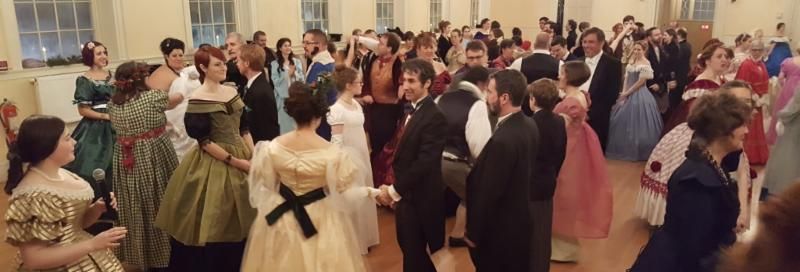
Ladies' and Gentlmen's Evening Dress
for the Ragtime Era: 1910-1920
by Katy Bishop and Patri & Barbara Pugliese

Dressing a Lady for a Ragtime Ball
Fashionable gown styles varied from year to year during the 1910's. For
consistency's sake, the styles chosen by The Commonwealth Vintage Dancers for
their performing gowns are those typical for the years 1913 to 1914. When
designing a gown to be worn at any of our social balls please don't feel
obligated to follow this narrow range; styles from the entire decade are equally
appropriate, as are modern gowns which are evocative of the period rather than
strict reproductions. We want our ball patrons to come and enjoy the evening,
and partake in elaborate costuming if they wish but it is certainly not required.
Evening Gowns of the 1910's Ladies' evening dress of this era often consist of a
high- waisted gown (though the waist placement varys somewhat from high to natural to low waisted
styles throughout the decade), usually in soft fabric such as chiffon or lightweight satin, often
ornamented with elaborate lace, silk brocades or beadwork and draped asymmetrically. The long
skirt should have enough fullness for dancing.
Skirts often would be made in many layers with elaborately draped overskirts in lightweight
materials in various types of silk or lace. Skirts are usually draped in such a way that the
rather full skirt falls in a fairly narrow silhouette but because of the nature of the draping
great freedom of movement is possible. Colors can be pastels or jewel tones, with contrasting,
striking color combinations as well as subtle tone on tone combinations.
The illustrations here are arranged chronologically, and show the evolution of styles
throughout the decade. from 1912 to 1919.
Accessories
Full length white gloves would complete the outfit splendidly. Shoes in a color to match or
compliment the gown, with a medium height heel of 1½-2 inches, such as Capezio character shoes are
comfortable for Ragtime dancing. Hair should be worn up and was usually dressed with decorative
headbands, ornaments, or feathers.
Outerwear
While travelling to the Ball one might wish to wear a cocoon coat or fanciful evening wrap. A few
examples are shown here. One from 1914 in red drapey silk, another, from 1919, in pink patterned
brocade has white fur or velvet trim, behind it are a red satin cloak with black fur trim and a
royal blue cape with brown fur trim. Capes in rich satins, brocade or velvet are also an easy and
luxurious alternative.
An old evening dress from your closet or local thrift store may well capture the spirit of
the dresses of this period - if not as they stand, then perhaps with a small amount of
modification such as adding a draped outer skirt.
Patterns Past Patterns has several reproduction patterns (for the experienced seamstress)
in their Vintage Revivals pattern line, some are day dress patterns but with shortened sleeves
or more open necklines they can easily be converted to evening styles. Some of the most useful
include: skirt patterns #7035, #5328, #7947, #8390 (with the addition of a long underskirt) and
#5462, tea gown #8109, dresses #8211, #9115 and #6053, and overskirts #9122. Combination #4574
or princess slip #9206 are great to wear under your corset. For a wrap there is pattern #7244.
Laughing Moon mercantile has a ca. 1910 evening dress pattern, #104. Sense and Sensibility
has 1910s Tea Gown pattern. Folkwear Pattern has an Afternoon Tea Dress Pattern (though the
skirt is not draped to allow ease of movement and is too narrow for dancing) Simplicity,
Butterick and Vogue Patterns also often have period style patterns, though we cannot vouch for
their accuracy. Most of these would benefit from theuse of natural fibers and the elimination of
zippers and the addition of hooks and eyes. (we cannot guarantee that all patterns are still
available)
Please feel free to contact
for further information
or advice. One can also visit
Vintage Victorian's Costume links page for more resources
 |
|
 |
|
Men's Evening Wear of the Ragtime Era Gentlemen's evening dress of this era is fairly
similar to modern formal wear consisting of a black tail coat or tuxedo jacket. White formal shirts
can have wing tip collars; vests and bow ties should be either white or black (cummerbunds are not
appropriate). White gloves add the final touch of formality for ballroom wear. Flexible soled shoes
such as Capezio black jazz oxfords are quite suitable for dancing.
We have illustrated here a tailcoat suit from 1920 with white waistcoat and white tie, with top
hat, white gloves and cane. Also a tuxedo suit, also from 1920, with black waistcoat and tie. The
Tuxedo is a more informal alternative to the tailcoat. Below is a scene from 1919 with a new style
of double breasted dinner jacket (described as being a new style fashionable for young men in 1919),
a more traditional single breasted tuxedo jacket and a formal tailcoat (swallowtail) suit. White
waistcoast would generally be worn with tailcoats and black with tuxedo jackets in this period. The
seated lady is wearing a very simple lightweight silk dancing dress.
|
 |
As in the nineteenth century, the function of men's dress is to provide a
setting that will allow the ladies to show off their own gowns all the more
brilliantly. A gentleman wearing a plain dark suit can be confident that the
details of his dress will pretty much escape notice and that he therefore need
not be overly concerned with the matter.
|