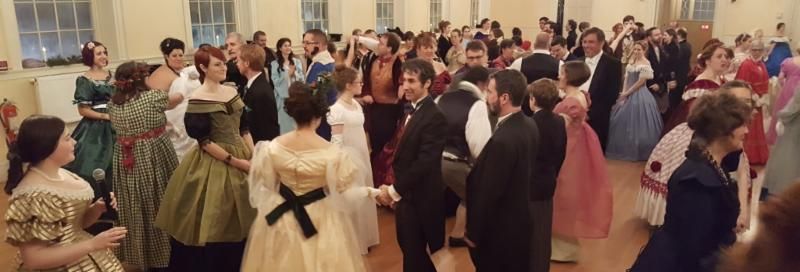
In general, the dances feature a mix of
teaching and social dance; beginners are welcome; clean, soft-soled shoes
are desirable; period costume adds to the ambience but it not necessary.
For more information, feel free to call (617) 230-9572, or email
Vintage Dance, in general, is a name given to historical social dances originally popular from about 1812 (Jane Austen's "Regency"
era) to about 1920 (the beginning of the "Jazz Age"). Our Tea Dances cover this entire range, with a little more emphasis on the "Civil
War Era" of the 1860s, and try to maintain a balance between teaching and dancing, so that it serves as both an educational and social
occasion. We also serve tea and have delicious potluck refreshments.
Each afternoon is a mix of "set dances" and "couple dances". The set dances are always taught, and suitable for all ages and levels of
experience or lack thereof. Examples of set dances would be The Virginia Reel, Sir Roger de Coverley, The Quadrille, and Les Lanciers,
or Lancers. We usually focus on one or two couple dances to teach, and let the others take care of themselves. People with practically
ANY other dance experience will know some of the couple dances, such as waltz, polka, schottische, galop, tango, foxtrot, one-step, and
two-step.
Some couple dances will be taught at the beginner level, but more advanced dancers will be free to practice their more advanced steps.
Some months, we will teach beginning steps for a number of different dances of the period; some months, we will look at a particular
dance and dive into it a little more deeply.
We have a selection of different teachers through the year, and mix up time periods. As mentioned before, our historical range
extends from the Regency Era (1811-1820) through the beginning of the Jazz Age (1920s). In dance terms, that's from the introduction of
the Waltz to the heyday of the Fox Trot and Charleston; it also covers the gradual replacement of the Country Dance by the Quadrille,
the rise and fall of the Polka; the Galop or Galopade; the introduction of the Tango, the One Step, and the Hesitation Waltz; and
briefly popular dances such as the Maxixe, the Half and Half, and the Lulu Fado. That's a lot of dances and only skims the high points.
We don't do all the dances on any one afternoon. We won't necessarily even do them all over the course of the year.
Previous Experience? Partners?
You don't need any previous experience, nor to bring your own partner. Some
dances will always be taught, and we change partners frequently, in fact, during
the entirety of the historical range we cover, it was considered very rude
to dance more than twice at one dance with any single partner, even your own
spouse.
Music
Most Tea Dances have live music. The Ad-hoc Waltz and Quadrille Band frequently provides our dance music.
Admission
Admission is $9. Student rate is only $5.
Volunteers
If you are interested in helping serve refreshments, or in making refreshments,
or helping decorate the hall, or publicity, or flier design, please contact
Michael: (617) 230-9572, or email
.
Dress & Shoes
There is no specific dress code. When pressed for space, we say: "Modern casual
dress and historical semi-formal afternoon wear are all welcome." Since we
have more space here, let's examine that in more detail.
Historical Costume: If you have historical costumes, the period of each dance
is usually shown in the schedule, and varies from month to month. Ideally,
you would wear something "nice" intended as afternoon wear, not work
clothes, not formal evening wear. However, any period costume will be welcomed.
Making do with things from your closet: If you want to dress up, but haven't
done this before, you can call our clothing historians, Katy and Barbara, and
they can help you choose the most appopriate of those clothes that you already
own. Contact me to get their phone numbers: (617) 964-7684, or email
.
Modern Costume: If you aren't interested in historical costume, you're still
absolutely welcome. Please wear something "nice"; for gentlemen, we prefer
something better than jeans and a T-shirt and ask that you not wear shorts;
for ladies, in addition, we prefer that you not wear a very short skirt, and
skirts or dresses are preferred rather than trousers. But, these are preferences,
not requirements.
Shoes: We have a beautiful venue with a nice floor in good condition,
and we ask that you bring a pair of shoes that are not street shoes, or that
have been cleaned very well, to dance in. Suede soled dance shoes are excellent.
For ladies, for ragtime and nineteen-twenties themed dances, medium height
heels can be helpful; so-called "Character Shoes" are ideal. For
19th century dances, flats are preferred.
Location
The Masonic Hall
1950 Mass. Ave. (Porter Square)
Cambridge, Massachusetts
Directions
It's pretty much across the street from the Porter Square T Station and Commuter Rail Stop. Come out of the station, face north (away from Harvard Square, with the supermarket parking lot on your right), cross to the west side of the street, and walk one block north. The hall will be on the left, with large Greek columns in front (don't mix it up with the Greek restaurant!) 1950 Massachusetts Avenue. Enter through the main doors and walk downstairs.
Driving:
Google Map of the Masonic Hall
Parking:
Being Sunday, all public, metered, spots are free. The supermarket lot, however, is a private lot and is patrolled regularly even on Sundays, so park ANYWHERE ELSE. They will TOW.
Mailing List
If you aren't already on our mailing list, it might be a good idea to join;
it's low traffic, and high signal to noise ratio. It's a closed list, and
so far that's been working to keep out the spam. Postings are almost exclusively
notices about upcoming vintage dances, with a small number of allied events
thrown in. To join, send an email to me at
.