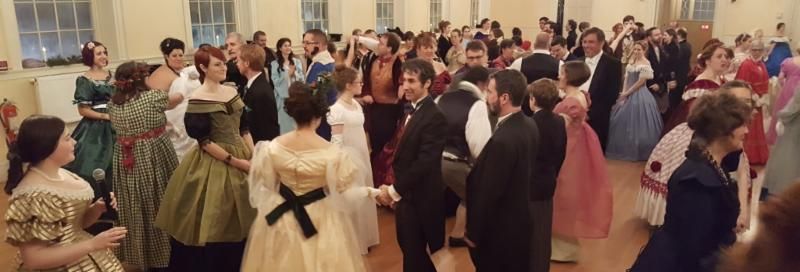
Etiquette Hints for the Mid-Ninteenth Century Ball Room Compiled by Patri & Barbara Pugliese
Entering a Ball-Room On entering a ball-room, all thought of self should be dismissed. The petty ambition of endeavoring to create a
sensation by either dress, loud talking, or unusual behavior, is to be condemned; also the effort to monopolize a certain part of the
room during the evening, or of forming exclusive circles when unanimity and good feeling should prevail, are, to say the least,
exceptionable.
(Hillgrove, A Complete Practical Guide to the Art of Dancing, New York: 1863, p. 24.)
The Effect of Dress Ladies should remember that men look to the effect of dress in setting off the figure and countenance of a lady,
rather than to its cost. Few men form estimates of the value of ladies’ dress. This is a subject for female criticism. Beauty of person
and elegance of manners in woman will always command more admiration from the other sex than costliness of clothing.
(Hillgrove, p. 18.)
Dressing for a Ball Be very careful, when dressing for a ball, that the hair is firmly fastened, and the coiffure properly adjusted.
Nothing is more annoying than to have the hair loosen or the head-dress fall off in a crowded ball room.
(Florence Hartley, The Ladies’
Book of Etiquette, and Manual of Politeness. Boston: 1860, p. 167.)
Gloves Draw on your gloves (white or yellow) in the dressing-room, and do not be for one moment with them off in the
dancing-rooms. At supper take them off; nothing is more preposterous than to eat in gloves.
(Henry P. Willis, Etiquette, and the Usages
of Society. New York: 1860, p. 22.)
Invitation to Dance In inviting a lady to dance with you, the words, ’Will you honor me with your hand for a quadrille?’ or
’Shall I have the honor of dancing this set with you?’ are more used now than ’Shall I have the pleasure?’ or ’Will you give me the
pleasure of dancing with you?’
(Cecil B. Hartley, The Gentlemen’s Book of Etiquette. Philadelphia: 1860, p. 93.)
Refusal of a Dance A young lady should be very careful how she refuses to dance with a gentleman; and above all she must take care not
to accept two gentlemen for one dance. Many duels have resulted from this thoughtlessness.
(Mrs. Hale, Manners; or, Happy Homes and
Good Society. Boston: 1868, p. 286.)
Handling of Bouquets & Fans If your partner has a bouquet, handkerchief, or fan in her hand, do not offer to carry them for her. If she finds
they embarrass her, she will request you to hold them for her, but etiquette requires you not to notice them, unless she speaks of them
first.
(Cecil B. Hartley, p.96.)
Correcting Others When in the Ball-Room When an unpracticed dancer makes a mistake, we may apprise him of his error; but it would be very impolite to have
the air of giving him a lesson.
(Willis, p. 23.)
Escorting your Partner after Dancing When the dance is over, offer your arm to your partner, and enquire whether she prefers to go immediately to her
seat, or wishes to promenade. If she chooses the former, conduct her to her seat, stand near her a few moments, chatting, then bow, and
give other gentlemen an opportunity of addressing her. If she prefers to promenade, walk with her until she expresses a wish to sit
down. Enquire, before you leave her, whether you can be of any service, and, if the supper-room is open, invite her to go in there with
you.
(Cecil B. Hartley, p. 93.)
Escorting a Lady to the Supper-Room Every gentleman should escort a lady to the supper-room, and after attending to her wants or tastes, never forget to
return with her to the ball or drawing rooms, for nothing can be more impolite than to leave an ’unprotected female’ to shift for
herself amid the tumult of a crowd of modern party-guzzlers.
(Anon., Bazar Book of Decorum. New York: 1870, p. 228.)
Choosing Partners Throughout a Dance At private parties ladies and gentlemen should not dance exclusively with the same partners, if by so doing they
exclude others from desirable company. We may, however, without impropriety ask a lady to join us the second time in a dance. We should
treat all courteously; and, not manifesting preference for any one in particular, be ready to dance with whoever may need a partner.
(Hillgrove, p. 21.)
|